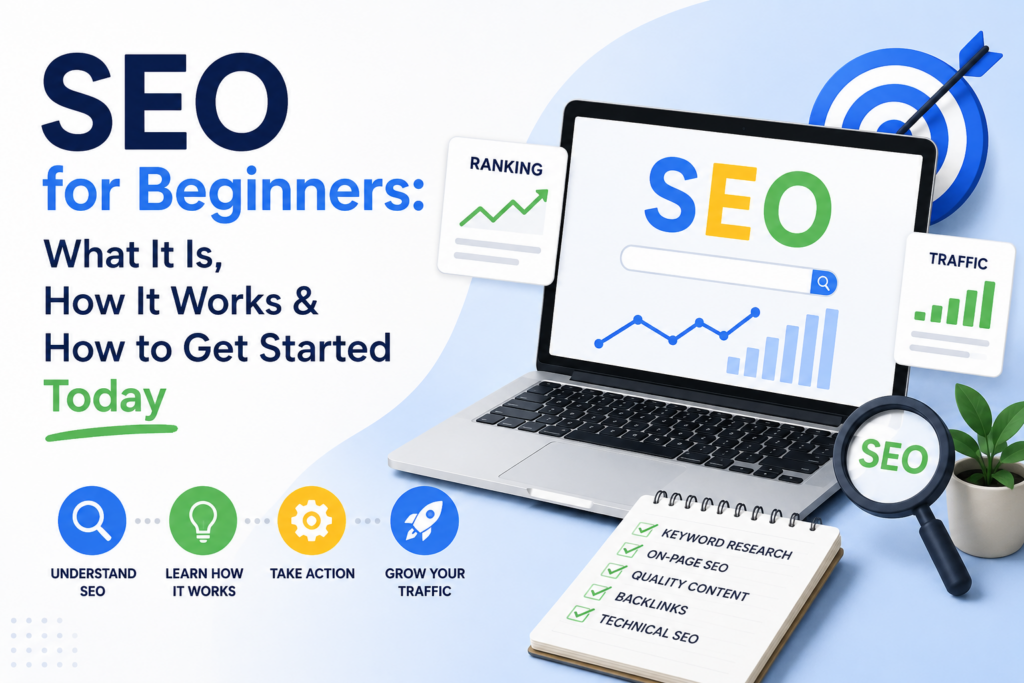
SEO for Beginners: What It Is, How It Works & How to Get Started Today

Okay, I have to say this — if you’ve been hearing the word “SEO” everywhere and nodding along like you totally get it… but secretly have zero idea what it means — this blog is written just for YOU. And honestly? I’m SO excited to break this down for you today because once it clicks, it changes everything about how you think about the internet. Let’s go! First Things First — What Even IS SEO? SEO stands for Search Engine Optimization. I know, that sounds fancy and technical, but stay with me — it’s actually super simple once you see it in action. Here’s the best way I can explain it: imagine you opened a brand new coffee shop in your city. It’s beautiful, the coffee is amazing, but… it’s hidden in a tiny alley with no signboard. Nobody can find you! Now imagine someone waves a magic wand and suddenly your shop appears at the top of Google every time someone searches “best coffee near me.” That magic wand? That’s SEO. SEO is simply the practice of making your website easier for Google (and other search engines) to find, understand, and recommend to people who are searching for what you offer. Awareness Check: Most people don’t scroll past the first page of Google results. In fact, the #1 result gets nearly 28% of all clicks. So if you’re not on page one, you’re practically invisible online. How Does Google Actually Decide Who Shows Up First? This is where it gets really interesting — and I LOVE this part! Google uses a complex algorithm (basically a set of rules) to decide which websites deserve to show up at the top. It looks at hundreds of signals, but the big three come down to: 1. Relevance Does your content actually answer what the person searched for? If someone types “how to bake chocolate cake” and your page is literally about chocolate cake — great news, you’re relevant! 2. Authority Does Google trust your website? Authority is built when other websites link back to yours (called backlinks). Think of it like this — if 50 respected chefs recommend your bakery, people will trust it more. Same idea online. 3. Experience Is your website fast, mobile-friendly, and easy to navigate? Google cares deeply about how users feel when they land on your site. A slow, clunky website? Google notices — and it pushes you down. Here’s a question for you: When was the last time you checked how fast your own website loads? Go on — Google “PageSpeed Insights” and test it right now. I’ll wait! The 3 Core Pillars of SEO You Need to Know Ready for the good stuff? SEO has three main areas you need to focus on. Think of them like the legs of a stool — you need all three for it to stand! Pillar 1: On-Page SEO This is everything that lives on your website — your content, your titles, your headings, your keywords, your images. On-Page SEO is about making sure Google can read your content and understand exactly what it’s about. Quick win: Every blog post or page should target one main keyword and include it naturally in your title, first paragraph, and a few headings. Pillar 2: Off-Page SEO This is everything that happens outside your website — mainly building backlinks. When other credible sites link to your content, it tells Google “hey, this site knows what it’s talking about!” Start small: guest posting on other blogs, getting listed in directories, or even sharing your content on social media can all help build your authority over time. Pillar 3: Technical SEO This is the behind-the-scenes stuff — making sure your site is fast, secure (HTTPS!), mobile-friendly, and structured in a way that Google’s bots can easily crawl and index. Don’t panic if this sounds overwhelming! You don’t need to master all of this on day one. Progress over perfection, always. 🙌 What Are Keywords and Why Do They Matter SO Much? Okay, quick question — how do you find anything on Google? You type words into the search bar, right? Those words are called keywords, and they are the absolute foundation of SEO. Keywords are the bridge between what people are searching for and the content you create. Your job as a website owner is to figure out: For example, if you run a fitness blog, you might target keywords like “home workout for beginners” or “how to lose weight without a gym.” These are real phrases people search for every single day! Hook: Here’s something that blew my mind when I first learned it — some keywords get searched millions of times per month. Imagine even 1% of those visitors landing on YOUR website. That’s the power of SEO done right. Free tools to find keywords: Google Keyword Planner, Ubersuggest, and AnswerThePublic are amazing starting points — and they’re free! How to Get Started With SEO Today (Yes, TODAY!) I know what you’re thinking — “this all sounds great, but where do I actually START?” I’ve got you! Here’s your beginner action plan: Step 1: Set up Google Search Console This free tool by Google shows you exactly how your site is performing in search — what keywords you’re ranking for, which pages get clicks, and any technical issues. It takes 10 minutes to set up and it’s a complete game-changer. Step 2: Research 5 keywords in your niche Use Ubersuggest (free!) and find 5 keywords your audience is searching for. Aim for “low competition” keywords when you’re starting out — they’re easier to rank for. Step 3: Write your first SEO-optimized blog post Pick one of your keywords and write a helpful, detailed post that genuinely answers the reader’s question. Use the keyword in your title, intro, and a couple of headings. Keep it natural — never stuff keywords in awkwardly! Step 4: Optimize your page titles and meta descriptions Every page on your website should have a unique title tag

SEO for Beginners: What It Is, How It Works & How to Get Started Today Read More »
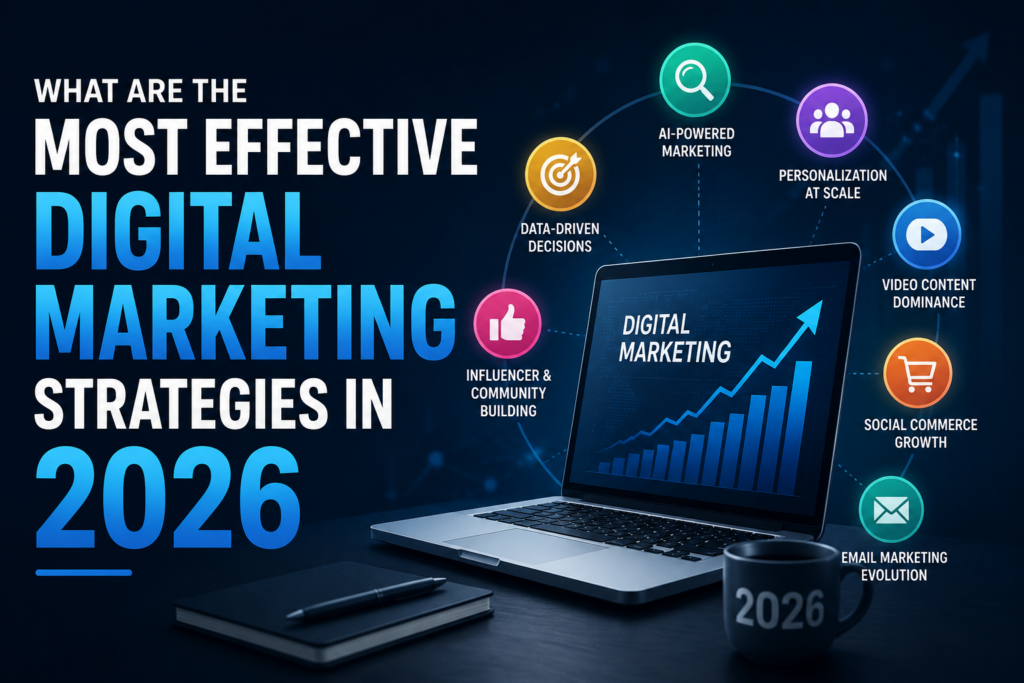
What are the most effective digital marketing strategies in 2026?

Every year someone says “marketing has changed forever!” and then everything mostly stays the same. But 2026 genuinely feels different to me — and I’ve been in this long enough to know the difference between a trend and a tectonic shift. This is the latter. So grab your coffee. Let me tell you what’s actually working right now, and more importantly, what it means for you. AI isn’t coming for your job — but it is changing it completely Let’s start with the elephant in the room. AI. I know the word makes some people roll their eyes and others break into a cold sweat. But here’s what I’ve seen on the ground: the marketers who are thriving right now aren’t the ones who use AI the most. They’re the ones who use it the smartest. AI today is a full strategic layer — analyzing behavior, generating content variations, optimizing campaigns in real time. The teams winning in 2026 are using it to move faster and think deeper, while keeping human judgment front and center for the stuff that actually matters: creative direction, brand voice, and reading the room. The role of a marketer has shifted from execution to interpretation. You’re no longer the person who writes all the copy. You’re the person who knows what good copy looks like — and directs the machine to get there. That distinction is everything. Personalization without trust is just surveillance Here’s a question worth sitting with: are you personalizing for your customer, or for your conversion rate? Because there’s a difference — and in 2026, customers can feel it. Seventy-five percent of consumers say they’re more likely to buy from brands delivering genuinely personalized content. But that same group is increasingly allergic to brands that feel like they’re being watched rather than understood. The shift I’m most excited about is zero-party data. Instead of inferring what people want from their behavior, you just… ask them. Preference centers, surveys, loyalty programs that let customers define what they want to receive and when. It sounds almost too simple. But it works, because it’s respectful. And in a world drowning in noise, respect is a differentiator. The dangerous assumption killing your SEO strategy right now Here’s the dangerous assumption I see everywhere: “SEO still works the way it used to, we just need better keywords.” It doesn’t. And if that’s your strategy, you’re optimizing for a search engine that no longer fully exists. AI-powered search has rewired the whole thing. Instead of a list of blue links, people now get synthesized answers. Your content is no longer competing for a click — it’s competing to be the source an AI cites. That is a fundamentally different game. Google’s own teams are calling it Generative Engine Optimisation. The idea is to build a rich library of authoritative, genuinely helpful content that AI systems can draw from when answering conversational queries. You’re not targeting a keyword anymore. You’re trying to become the most trustworthy voice in your space — so that when someone asks an AI assistant a question in your lane, your perspective is baked into the answer. Add voice search to that mix — natural language queries, “near me” searches through smart speakers — and the message is clear: write for humans, structure for machines, and stop chasing terms that no longer tell the whole story. Video is trust, not just content I used to think video was a nice-to-have. Now I think it’s one of the most powerful trust-building tools a brand has. And here’s why: most buyers today never talk to your team before making a decision. They research quietly, form opinions on their own, and show up (if they show up) already 70% decided. So what’s building trust in that gap, when no one is in the room? Video. Your CEO explaining pricing. Your team walking through common objections. A subject matter expert breaking down something complicated in plain language. That’s the stuff that makes a stranger feel like they know you — before they’ve ever sent an email. Short-form video on TikTok, YouTube, and Instagram leads on ROI right now, with 21% of marketers saying it delivers the highest return of any content type. But the format matters less than the intention. Teach something real. Be a person, not a brand voice. That’s what earns the trust that converts. Your buyer doesn’t want to be sold to — they want to decide on their own terms This is the shift that ties everything together. Modern buyers want control. They want to find the information they need, evaluate options at their own pace, and reach out when they’re ready — not when your funnel tells them to. The brands building the most momentum right now are the ones designing for that behavior. Pricing calculators. Self-assessment tools. Comparison guides. Websites that educate instead of performing urgency. When you give someone the tools to make a confident decision on their own, they move faster. And they trust you more for not pressuring them. Paid media fits into this too — but differently than before. The brands winning with ads in 2026 aren’t using them to rescue a weak funnel. They’re using them to amplify what’s already working organically. Ads as accelerant, not substitute. Here’s the closing truth-bomb I want to leave you with: the biggest mistake in digital marketing right now isn’t using the wrong channel. It’s having a collection of tactics instead of a compounding strategy. Tactics get you a spike. Strategy gets you somewhere. The brands I watch doing this well aren’t chasing every new trend. They’re building systems — connected channels, clear messaging, genuine trust signals — and improving them consistently. That’s what compounds. That’s what eventually becomes very hard to compete with. So here’s the real question: are you building a strategy that gets stronger over time, or a set of campaigns you have to restart every quarter? Because one of those is a treadmill. And I know which

What are the most effective digital marketing strategies in 2026? Read More »

chatgpt image may 30, 2026, 11 18 12 pm

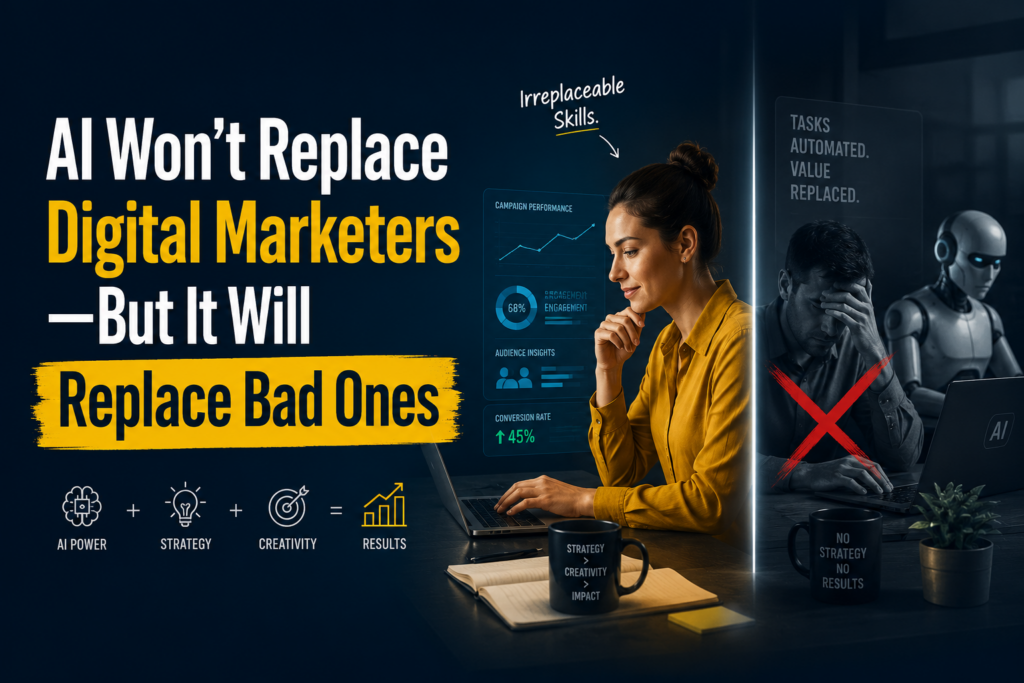
AI Won’t Replace Digital Marketers —But It Will Replace Bad Ones

Okay, let’s talk about the elephant in every marketing Slack channel right now — is AI coming for your job? I’ll be straight with you: the short answer is no… and also kind of yes. And before you close this tab, hear me out — because I genuinely believe what I’m about to say will either put your mind at ease OR give you the wake-up call you didn’t know you needed. Either way? You’re walking away better for it. I’ve been in digital marketing long enough to remember when “SEO” sounded scary, when social media was “just a fad,” and when everyone panicked that automation would kill email marketing. Spoiler: none of those things died. They evolved. And so must we. First — Let’s Talk About What AI Actually DoesAI is insanely good at repetitive, pattern-based tasks. Writing 50 subject line variations? Done in 10 seconds. A/B testing ad copy across 100 segments? Easy. Scheduling posts, resizing creatives, generating first drafts, summarising reports — AI absolutely crushes it. So if AI can do all of that… why do we still need human marketers at all?Because here’s what AI cannot do — yet, and probably for a long time: it can’t understand the raw, messy, contradictory human beings on the other side of your ad. It doesn’t know why someone cries at a McDonald’s commercial or why a brand tweet goes viral over absolutely nothing. It can analyse human behaviour — but it can’t feel it. Strategy, storytelling, empathy, cultural nuance, brand intuition — that’s YOU. That’s your superpower. And right now, AI needs you to wield it. But Here’s Where It Gets Real 👀The marketers who ARE getting replaced? They’re not being replaced by AI. They’re being replaced by other marketers — who use AI.That’s the truth nobody wants to say out loud at the conference. If your entire value as a marketer is writing captions, resizing banners, or scheduling posts — that workflow is already automated. If you’re still manually writing 200 product descriptions without touching a single AI tool, someone else is doing that in 20 minutes and spending the rest of their day on strategy. 73%of marketers using AI report higher productivity3xfaster content output with AI-assisted workflows61%of top CMOs plan to expand AI budgets in 2025These aren’t scare stats — they’re opportunity stats. The marketers leaning into AI? They’re not working harder. They’re working smarter, delivering more, and frankly, becoming indispensable. So What Does a “Good” Marketer Look Like in the AI Era?🤔 Ask yourself honestly — are you someone who uses AI as a launchpad, or are you someone who’s still not sure how to write a proper ChatGPT prompt?No judgment! But awareness is everything. Here’s what I see the best marketers doing right now — and it’s exciting, honestly: They treat AI as a junior team member. They brief it, review its work, edit it, and push it further. They don’t just accept the first output. They use their human marketing brain to make the AI’s work actually good. They go deeper on strategy. Because AI handles the execution layer, great marketers now have MORE time to obsess over the customer journey, positioning, brand voice, and long-term campaigns that move the needle. They stay culturally plugged in. AI has a training cutoff. It doesn’t know what meme is dominating right now, what’s culturally sensitive this week, or why your Gen Z audience is over a certain aesthetic. You do. That’s gold. They learn fast. The half-life of a marketing skill is getting shorter. The best in the game are constantly testing new tools, watching what converts, and adapting — not waiting for a 12-week course to tell them what’s already outdated. The most dangerous thing you can do right now is assume your skills are safe because they’ve always been enough.The Awareness Shift You Need To MakeHere’s the thing I want you to really sit with: this isn’t about fear. This is about positioning. The marketers who are thriving in 2025 aren’t the ones with the most followers or the fanciest portfolio — they’re the ones who saw AI coming, got curious instead of defensive, and levelled up. 🤔 Where are YOU on that spectrum right now? Curious or defensive? Experimenting or waiting?Because the window to be an early mover is still open — but it won’t be forever. The marketers who adapt now will be the ones leading teams, setting strategy, and commanding bigger salaries in three years. The ones who don’t will find their scope shrinking, their value questioned, and their role restructured. And honestly? That’s not AI’s fault. That’s just the nature of every industry shift that’s ever happened. The printers who learned desktop publishing didn’t disappear — they became art directors. The travel agents who embraced the internet became high-end experience curators. Same energy. Here’s My Honest Take — As a Marketer to AnotherI’m genuinely excited about AI in marketing. Not because it makes us redundant — but because it removes the boring, repetitive stuff that was always underneath our pay grade anyway. It frees us up to do the human stuff better. The creative work, the brave campaigns, the cultural bets, the brand building that actually makes people feel something. AI gives you back your time. What you do with that time is the question. So — will AI replace digital marketers? No. Will it replace digital marketers who refuse to grow? Absolutely. And honestly, that was always going to happen eventually. The only difference is the timeline just got a lot shorter.

AI Won’t Replace Digital Marketers —But It Will Replace Bad Ones Read More »

DIGITAL MARKETER

Sale

Day
Hr
Min
Sec

Join Our Mailing List and Receive a 45% Discount Code

Yes,I Want This!
No thanks I don't want to save